Wednesday, 24 February 2010
Fashion Shows
At last I got the video from the last Fashion show and even putting up edited highlights is going to be a 'part work'! There's about 90 minutes worth to edit downThe first part is here. I KNOW it's called part two, but the first one is Gini doing the opening musical number and a lot of costume people won't want to see it. (if you do, go here)! I'll put up the rest as they get finished.The videos were taken on a domestic camera, but I think Gabi & her husband have done very well!
We are all ready in the process of writing the show for March and have ideas for November, which is the 20th Anniversary of T.O.R.M, so that one has to be spectacular! Well, even more spectacular!


Thursday, 28 January 2010
Fashion Forensics ©
 It has long been an ambition of Ginis' to let others see what she is privileged to investigate. In her work, a lot of access is granted to 'touch and handle' extant garments in the archives of museums and it does seem a shame not to let others see them. If people are lucky enough to see these they are usually in glossy 'coffee table' books with maybe two pictures! Museums unfortunately are working with limited display space and only a few of pieces in a collection are ever on view to the public at one time. The Kyoto Institute is a good example where they have about 60,000 photographs of their collection and have produced wonderful books of what some of our friends call 'frock porn'(!). If you ever go there you will find about half a dozen outfits on display - the rest are 'in the archive'! The V.&A. Museum are at the moment trying to close down the musical instrument section to give more room to the textile collection, which does seem a bit like throwing the baby out with the bathwater. (Gets off high horse - and back to the subject)!
We have an idea of making videos of some of the initial inspections, which will show the materials, structure, construction, previous conservation, alterations - almost the C.S.I of clothing!
They will be of interesting pieces in the lesser known collections. Did you know that Bassetlaw Museum has about 5,000 costume pieces, for instance? In the meantime, we have a web album of the one one the left A victorian ensemble of 1872. The staff and indeed, the public were fascinated at the detail that came out. I'll try and put the captions up very soon - when the phone stops ringing!
Wednesday, 13 January 2010
The Music Lesson

 Well, A Happy New Year to you all! I hope all our British & European readers aren't suffering too much in the truly awful weather conditions. We actually didn't get stuck in the snow, but our car had a little problem and refused to start.
It took our Automobile Association, 6 days to get it sorted! ( I would have written A.A. there but that would look like we had a different problem! -"My name is Tony and I haven't had car trouble for six months"!) Anyway, the snow stopped customers getting to us, suppliers delivering to us and us delivering to customers, which caused a few headaches.
A break in the weather did give Gini a chance to get to Birmingham Museum to deliver and set up the display shown on the left, which is a copy of the ensemble shown in the painting "The Music Lesson" by Jacob Ochtervelt (1634-1682). Both gown and painting are on show at Birmingham Museum & Art Gallery.
Deeper analysis of this portrait raised some questions about the bodice/jacket and its construction - particularly the back. Looking at other portraits by Ochtervelt and his contemporaries, working in the low countries at this time period and examining other extant garments, did not resolve the questions and it may be that either the jacket/bodice is somewhat anomalous, or that we have discovered a style for the period previously unrecorded. With only one painting pointing towards this style of bodice back we still cannot be sure.
Tuesday, 24 November 2009
Historical Fashion Review
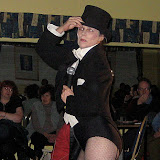 |
| Fashion Show November 2009 |
"My friends and I ALL forgot to bring our cameras with us, which was very annoying. It was a marvellous parade and it was great to be able to talk to people and to see the costumes at close hand and pick up some tips. You are all so talented!" Even the participants had a great time, which is lovely as they all donate their time and expertise gratis. Some of the ensembles in the review were truly amazing and we thank all the other costumiers for their efforts. Debbie Lough Costumes, My Lady's Wardrobe, Harman Hay, Prior Attire, Sarah Gilkes, Cloak'd & Dagger'd, Anne Laverick, Janes' Wardrobe, Amourclass, Jo Badger Historic Costumes and Dressing History. Other organisations helped as well, Chris Bruce from Plantaganet Events, Ian Pyecroft from Black Knight Historical, Kirsty Sherwood and Rachel Wanklin from Tamworth Castle, Lin from Birmingham Museum and a big thank you to all the costumiers customers and models, who 'strutted their stuff' (but VERY elegantly!). Thanks to all the 'dressers', stage managers, sound and light technicians who helped put some extra features into the show.
Apart from the fashion show, we met some of our 'mail order' customers from abroad for the first time. It was lovely to meet you all and we hope you enjoyed your stay in England. This show is getting very cosmopolitan and the number of visitors from other countries is astounding!
Sunday, 1 November 2009
Oyez! Oyez! Oyez!

A Town criers' clothing from the early part of the 18th Century. The client is the crier for Castle Donnington, a town in the midlands, which has had a town crier since the late 1200's!
This position going back so far, Terry decided that he ought to have an earlier costume than most town criers, who usually decide on a coachmans coat from the regency or early victorian - and because he liked the style!
I am aware that this blog is read in over 20 countries, so I'd better explain what a 'crier' did.
Really, he was a town officer who made public proclamations, normally using a trumpet or bell to gain the attention of the crowd, before bellowing the news or public notices as loudly as he possibly could! Usually announcing his presence by shouting 'Oyez! Oyez! Oyez! (or similar, it seems nobody can decide or find out what was originally done)!
Competitions are held throughout Britain for the loudest and best dressed crier - We think that Terry is in with a shout - for both categories!
Wednesday, 7 October 2009
French Hood & Feedback

We got some feedback on our first French hood kit this week :-
"Hi Gini, I think overall it took me about 10 hours. I had to hand sew nearly all including the French seams as my machine died whilst tackling the buckram early doors!. I really enjoyed making it, and it was fantastic value. I only added some more billaments from a local fantastic craft shop I found in Retford. The one really tricky part was the sewing of the final linen lining in the finished coif. Thanks for all your help it was a great experience bringing history alive; I cannot stop looking at it! Many thanks again, Sian".
Really nice to know when something works first time! The picture on the left shows the finished hood and we really think Sian did incredibly well for her first piece of historical clothing!
It's not the only nice feedback we've had lately. L wrote:-
"Btw, I went on to your website it's even better than ever - wow! The blog is fab & as for the gallery...that calash is to die for, & as for the passementerie buttons...I was salivating! The heralds coat for Kp is sooo cute! It brightened my day up, that's for sure... "
N. Left us a lovely comment here.
A. A textile designer from Italy, thinks we're the best E.C.W supplier he's seen and hopefully he's going to come to The Original Re-enactors Market this year to meet us......
Simon wrote:- The costume is absolutely fantastic. I'm not lying when I say that it has exceeded all of my expectations!I love the close firm fit of the doublet. I appear to have lost around a stone in weight when I wear it! As soon as I can I'll get some photos sent up to you to add to your porfolio, if you wish.
(Yes, please Simon)!
I also ended up on Uberbrum (of all places!), while having a break at 'Talk like a pirate day'!
Thank you one and all, but be sure that we're not going to rest on our laurels and that there will be some new and exciting ensembles ready soon!
We are also working on the Fashion show for T.O.R.M in November. All ready, we have a spectacular show in prospect and we'll keep tweaking the show until it squeaks!
P.S Congratulations to Birmingham on getting TWO gold awards at 'Britain in bloom'! (See Here) One award is brilliant, two is outstanding!
Monday, 21 September 2009
'Anne Boleyn' French Hood

If people approach us at a show and their shopping list goes something on the lines of "Do you have any buckram, domette, black velvet, pearls...?" We could probably finish the list for them, as the chances are that they are looking to make a 'french hood'. Our first question is usually,"Have you made one before?" - as these can be tricky! If the customer is new to milinery we then try and explain what is required. "Do you have any white silk, millinery wire?".... and the list goes on.
We have decided to produce these in kit form and the kit will contain everything needed to make an 'Ann Boleyn style french hood'. All you need to add is needles, thread and have a day or two to spare! Full instructions will be included and we've put up a hidden step by step pictorial guide on picasa - that you will have access to - 50 photographs showing every step from the basic pieces to fitting the bilaments (ornaments).
Available in two sizes, Child (and small adults) and Adult.
Hopefully, these will save you running from one haberdashery shop to another to find what you need and discovering you have to buy far more than the quantity required - when you find it!
The only question left is, are you going to pluck the hair out on your forehead, as the tudors did, when you wear it?!
We made this one with a gold crescent so it would show up better in the photographs and the bilaments will be pearls only as in the original.
Sunday, 6 September 2009
A Dressing up Gown..........
 Built on a strict budget, this Elizabethan (tudor) gown is based on a 1580-1590 gown in the Nurnberg Museum. The front panel and sleeves of the Kirtle are of silk taffeta. A corded diamond pattern of linen has been applied and overlaid on this are 2,800 pearls and black bugle beads. The Kirtle sleeves are detachable. It is fully lined and has a heavy guard of linen at the hem.
The outer velvet gown has decorated 'guards' of black satin couched with black silk cord. The same decoration is applied over the shoulders and down the back, sleeves and collar.
The sleeves are possibly one of the most complicated patterns as it contains a heavy padded roll at the head and over this a boned skeletal structure which gives the shape. The outer velvet is
made up of many shaped panels, following the form given by the structure beneath. The Ruff is held up, by the collar, to frame the face.
 This Ensemble has a dedicated web album
here
Tuesday, 18 August 2009
A Coat of many stitches....

This one is a 'fair copy' of the boys red wool suit in the V.&.A (Ref:- No. T.327&A-1982)
The coat is made from the finest superfine melton wool and is raw edged at fronts, hems & cuffs. It is embroidered down the front, the centre back vents, the cuff tops and edges and the pockets in gold. It is fully lined and the fronts and cuffs are interfaced and then faced the same wool as the
outer. The neckedge is bound with 1/4" binding of the wool. All the linings, interfacings and facings are stitched in by hand in the same way as the originals were.
The Breeches are made from the same wool and lined in linen. They are also embroidered down the front outside leg to match the coat.
 Before work could proceed, a sample of the embroidery was produced so that decisions about the buttons could be made. After a great deal of research on passementerie buttons 1690 -1720 and a fruitless worldwide search for an acceptable button of the right size [1"], we decided that reproduction passementerie buttons were the only solution. Starting with finding or producing a workable button mould, which was a feat in itself, we ended up producing our own wooden moulds in house and with several samples to show our client, one of which took two hours to make!
The entire suit took 105 hours to produce, 20 of which were spent on the 39 buttons, 23 on designing and embroidery programming, 21 on actual embroidery and the rest on cut and makeup.
This outfit has its' own web album here
Sunday, 9 August 2009
Handing out Bouquets.......
I was in Birmingham this week as a 'costumed character' for the 'Britain in Bloom' competition.
The reactions of the everyday public to someone in costume proceeding from one venue to another seemed to amaze my 'handler', a lovely lady, who probably had never accompanied an 18th Century gentleman through the streets of central Birmingham before!
Having done this sort of thing for a few years, I find the responses are far less than they used to be. People are more used to seeing interpreters, fancy dress parties, costumed weddings and they find the appearance of someone in costume far less remarkable.
Probably the best reaction I ever got, was walking into a petrol station on the A40 a few years ago, at about 6 a.m, in full Cavalier outfit. The attendant was fast asleep with his head on the desk. He took a bit of waking and upon seeing me, he took off from his stool both horizontally and vertically for about 9 feet! The look on his face was picture! I wonder if he still has nightmares?............ Anyway, good luck to Birmingham in the competition. If they are looking for ideas for next year, I can't help but think of the Regency pleasure gardens.
The reactions of the everyday public to someone in costume proceeding from one venue to another seemed to amaze my 'handler', a lovely lady, who probably had never accompanied an 18th Century gentleman through the streets of central Birmingham before!
Having done this sort of thing for a few years, I find the responses are far less than they used to be. People are more used to seeing interpreters, fancy dress parties, costumed weddings and they find the appearance of someone in costume far less remarkable.
Probably the best reaction I ever got, was walking into a petrol station on the A40 a few years ago, at about 6 a.m, in full Cavalier outfit. The attendant was fast asleep with his head on the desk. He took a bit of waking and upon seeing me, he took off from his stool both horizontally and vertically for about 9 feet! The look on his face was picture! I wonder if he still has nightmares?............ Anyway, good luck to Birmingham in the competition. If they are looking for ideas for next year, I can't help but think of the Regency pleasure gardens.
For beauty of situation and variety of elegant scenes, these gardens [presumably Vauxhall] cannot be surpassed by any pleasure-ground in the Kingdom. It contains about sixteen acres with a great number of small, delightful groves, and charming lawns, intersected by serpentine walks, which at every turn meet with sweet, shady bowers, furnished with handsome seats, some canopied by nature, others by art.
It is also decorated with waterfalls, stone and thatched pavilions, a canal running through with two elegant cast-iron bridges thrown over it, after the manner of the Chinese. A sham castle planted with several pieces of cannon, bowling greens, swings, thatched umbrellas as a shelter from sudden rains and storms.
From the pavilions and bridges, an enlightened observer may fascinate his senses with the enchanting view of hills, vales, dales and magnificent structures that surround this Elysian Field.
Subscribe to:
Posts (Atom)


 Posts
Posts

